When it comes to your child’s health, waiting for a problem to become visible is rarely the best strategy. This is especially true in oral health. Many parents view a trip to the dentist as a routine check-up, but modern kids dental care is about much more than just counting teeth. It is about specific, proactive treatments designed to intervene early, ensuring that minor developmental pauses or early signs of decay don’t evolve into complex, expensive procedures later in life.
Effective kids dental care focuses on interception. By identifying soft enamel, habit-related jaw issues, or potential overcrowding before they become permanent fixtures of your child’s smile, we can alter the trajectory of their oral health. This article explores the specific treatments available for children and why early intervention is the key to a lifetime of confident smiles.
Why Early Kids Dental Treatment Matters

There is a common misconception that because baby teeth (primary teeth) eventually fall out, they require less aggressive treatment than adult teeth. The reality is quite the opposite. Primary teeth are the blueprint for the adult smile. They hold the necessary space for permanent teeth and guide them into the correct position.
If a baby tooth is lost prematurely due to decay or injury, the surrounding teeth can drift into the gap, causing severe overcrowding and bite issues that require extensive orthodontic work later. Furthermore, the enamel on baby teeth is thinner than on adult teeth, meaning decay can spread to the nerve much faster, leading to pain and infection.
Early kids dental treatments are not just about fixing a hole in a tooth; they are about preserving the architecture of the mouth. By treating issues the moment they arise—or preventing them entirely with protective measures—we reduce the likelihood of dental trauma and anxiety associated with complex emergency work.
Most Common Kids Dental Treatments Explained
Understanding what happens in the dental chair can alleviate anxiety for both parents and children. Here are the specific clinical treatments frequently performed to protect growing smiles.
Fissure Sealants
The chewing surfaces of back teeth (molars) are rough and uneven because they have small pits and grooves called fissures. These are prime locations for food particles and bacteria to hide, often too deep for toothbrush bristles to reach.
Fissure sealants are a protective plastic coating applied to these chewing surfaces. The sealant bonds to the tooth, creating a smooth barrier that prevents bacteria from settling in the grooves. It is a quick, painless procedure that requires no drilling and effectively “seals out” decay.
Fluoride Varnish Applications
While many toothpastes contain fluoride, professional fluoride varnish is a highly concentrated treatment applied directly to the teeth by a dentist. This treatment is crucial for children with “soft” enamel or those prone to cavities. The fluoride penetrates the enamel structure, remineralising weak spots and making the tooth surface more resistant to acid attacks from sugar and bacteria.
Stainless Steel Crowns
In instances where a baby molar has extensive decay or has undergone pulp therapy (a baby root canal), a standard filling may not be strong enough to withstand chewing forces. In these cases, a pre-formed stainless steel crown is placed over the tooth. This treatment saves the tooth, ensuring it remains in place until it falls out naturally, thereby maintaining the necessary space for the adult tooth.
Preventive Treatments That Protect Growing Teeth
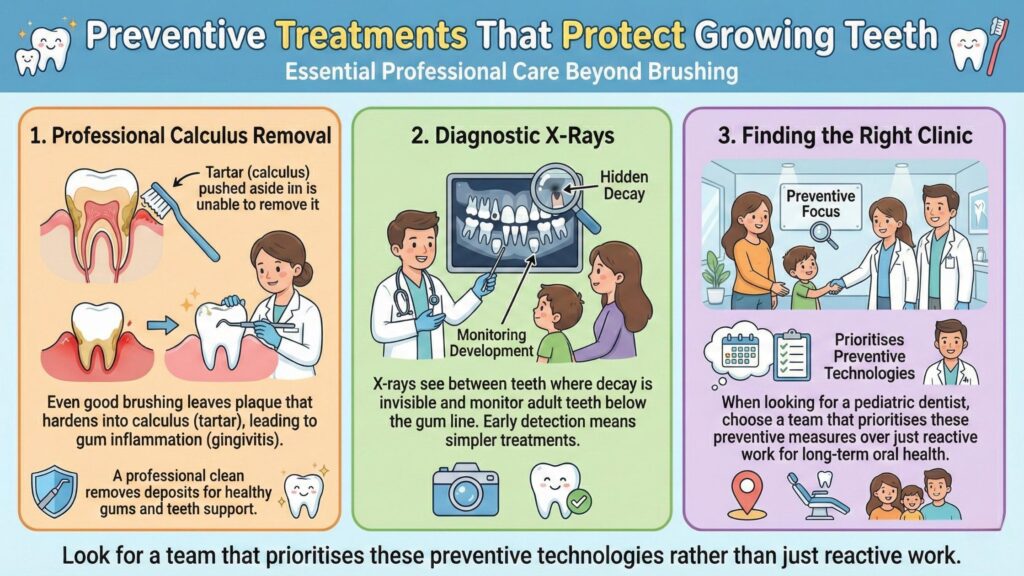
Prevention is the cornerstone of paediatric dentistry. While brushing at home is essential, professional preventive treatments provide a level of hygiene and protection that cannot be achieved domestically.
Professional Calculus Removal
Even with good brushing, plaque can harden into calculus (tartar), which cannot be removed with a toothbrush. If left untreated, this can lead to gum inflammation (gingivitis). A professional clean removes these deposits, ensuring healthy gums which are vital for supporting developing teeth.
Diagnostic X-Rays
X-rays are a diagnostic treatment tool. They allow dentists to see between the teeth where decay often starts and is invisible to the naked eye. They also allow for the monitoring of adult teeth developing below the gum line. Early detection via X-rays often means the difference between a small, simple filling and a complex extraction.
Finding the right clinic is essential for these preventive measures. If you are looking for the Best dentist near me for kids, look for a team that prioritises these preventive technologies rather than just reactive work.
Addressing Habits and Growth: Early Intervention
Many dental issues in children are not caused by sugar, but by habits and developmental patterns. Kids dental professionals are trained to spot the structural changes caused by thumb sucking, dummy use, and mouth breathing.
Habit Breakers
Prolonged thumb sucking or dummy use can reshape the upper jaw, narrowing it and pushing the front teeth forward (protrusion). If these habits persist beyond the age of three or four, passive appliances can be used to discourage the habit and allow the jaw to correct itself naturally before the bone hardens.
Mouth Breathing and Airway Assessment
Chronic mouth breathing can alter facial growth, leading to a long, narrow face and a recessed chin. It often indicates an airway issue or allergies. Early dental assessment can identify these physical signs. Treatment may involve referrals to ENT specialists or the use of appliances to expand the palate and open the airway.
Space Maintainers
If a child loses a primary tooth early due to trauma or decay, a space maintainer is a custom-made appliance (usually a metal band and loop) that holds the gap open. This prevents adjacent teeth from tilting into the space, ensuring the adult tooth underneath has room to erupt.
Early Orthodontic Assessments
We monitor the growth of the jaw to predict crowding issues. In some cases, early intervention using plates or expanders can widen the jaw to make room for adult teeth. This proactive approach to spacing and braces orthodontic treatment can significantly reduce the time a child needs to wear braces in their teenage years.
When Early Intervention Becomes Necessary
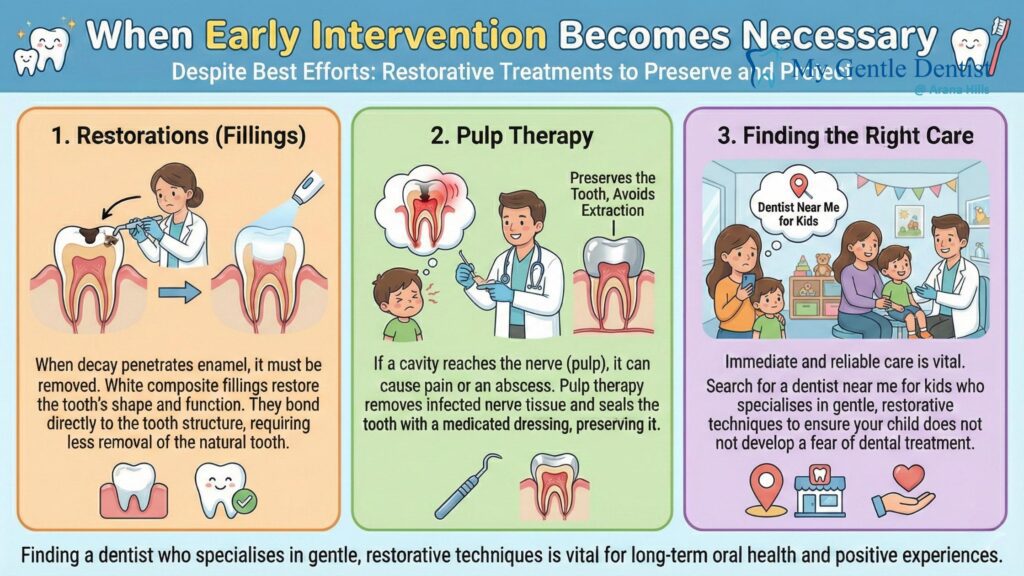
Despite our best efforts, restorative treatments are sometimes required. The goal of restorative kids dental work is always to eliminate pain and infection while preserving the tooth for as long as it is naturally needed.
Restorations (Fillings)
When decay penetrates the enamel, it must be removed. White composite fillings are used to restore the tooth’s shape and function. Unlike the silver amalgam fillings of the past, these bond directly to the tooth structure, requiring less removal of the natural tooth.
Pulp Therapy
If a cavity is deep enough to reach the nerve (pulp) of a baby tooth, it can cause an abscess or severe pain. Pulp therapy involves removing the infected part of the nerve and sealing the tooth with a medicated dressing. This preserves the tooth and avoids extraction.
When facing these situations, parents need immediate and reliable care. Searching for a dentist near me for kids who specialises in gentle, restorative techniques is vital to ensure your child does not develop a fear of dental treatment during these procedures.
The Role of a Child-Focused Dental Clinic
The environment in which treatment is delivered is almost as important as the treatment itself. A clinic designed for adults can feel sterile and intimidating to a young child. Conversely, a child-focused practice utilises specific techniques to manage behaviour and comfort.
- Tell-Show-Do: The dentist explains what they are going to do, shows the child the equipment (often on a finger or a model), and then performs the action. This removes the fear of the unknown.
- Smaller Equipment: Instruments sized for smaller mouths reduce discomfort and the sensation of being overwhelmed.
- Positive Reinforcement: shifting the focus to what the child is doing right builds confidence.
When parents search for a childrens dentist near me, they are usually looking for a team that understands these psychological nuances. The goal is to build a relationship of trust so that the child eventually takes ownership of their own oral health.
Why Parents Search for Specific Care
Parents today are more educated about oral health than ever before. They understand that general dentistry and paediatric-focused dentistry, while related, have different approaches. The anatomy of primary teeth differs from permanent teeth, and the rate at which dental issues progress in children is faster.
Consequently, parents look for providers who can offer continuity of care—from the first tooth through to adolescence. They need a provider who can handle the frantic emergency of a chipped tooth on the playground as calmly as a routine fluoride application.
Specific searches often reflect specific needs. For example, a parent might search for a childs dentist near me for kids when they have a child with sensory sensitivities or high anxiety, looking for a practice that explicitly caters to those requirements with patience and specialised sedation options if necessary.
Frequently Asked Questions About Kids Dental Treatments
1. When should my child have their first dental visit? It is recommended that a child sees a dentist by their first birthday or within six months of their first tooth appearing. This early visit is primarily about acclimating the child to the environment and checking for developmental markers.
2. Are dental X-rays safe for children? Yes. Modern digital X-rays use extremely low radiation doses—significantly less than traditional film X-rays. Lead aprons are used as an extra precaution. The risk of undiagnosed decay spreading to the nerve is far greater than the negligible risk of a digital X-ray.
3. Why fix a baby tooth if it’s going to fall out? Untreated decay in baby teeth can lead to infection, which may damage the developing adult tooth underneath. Furthermore, early loss of baby teeth causes crowding, leading to the need for complex orthodontic treatment later.
4. How can I prevent my child from needing fillings? A combination of home care (brushing twice daily with fluoride toothpaste) and professional treatments (regular cleans, fluoride varnish, and fissure sealants) is the best defence. Limiting sugary snacks and acidic drinks is also critical.
Conclusion
Investing in early kids dental treatments is an investment in your child’s future well-being. By moving beyond simple check-ups and embracing preventive treatments like sealants, fluoride applications, and early growth monitoring, you are protecting your child from pain and extensive dental work in the future.
Small issues in a developing mouth can become complex problems very quickly. Whether it is correcting a bite issue, sealing a deep groove, or treating early decay, timely intervention is key.
If you want to ensure your child’s smile is on the right track, don’t wait for a toothache to appear. Book a consultation today to discuss which preventive treatments are right for your child’s stage of development. Let’s work together to stop small problems from becoming big ones.